Book a briefing

/// REDH.CORE_ Hong Kong

REDH TECHNOLOGY LIMITED

From tokens
to embodiment.

REDH routes token traffic across the world’s models, keeps brands accurate inside AI answers, and equips humanoid robots with data, compute and hardware.

01Thesis/// REDH.THESIS_

Words, pixels and motion all end up as tokens.

Language models read and write in tokens. Video models cut frames into tokens. Robot models write actions as tokens too. Wherever intelligence flows, tokens settle the bill.

/// TOKENIZER.DEMO_

Illustrative
TextSentence → word pieces

Words, pixels and motion all end up as tokens.

11 tokens. A leading space rides with its word (·).

ImageFrame → 16 × 16 patches1

48 patches, one token each.

MotionArm path → action tokens2

    24 tokens: x, y, z and grip, each cut into 256 bins.

    Token meter

    Text
    11
    Image
    48
    Motion
    24

    83tokens metered

    Different inputs. The same unit on the bill.

    /// MARKET.READOUT_

    Tokens consumed per day in China3
    140trillion
    Tokens Google processes per month4
    3.2quadrillion
    Reported price of Stripe’s acquisition of OpenRouter5
    ≈US$7.5billion

    Tokens consumed in China since you opened this page3Estimate*

    0

    One block = 100 million tokens, moving at the estimated rate

    02Prism · The token hub/// REDH.PRISM_

    One API.
    Text, image, video.

    Compatible with the OpenAI, Claude and Gemini API formats. Each request is routed by price, latency or throughput, fails over when an upstream falters, and lands on the ledger.

    Text
    • Claude Opus 5.5
    • GPT-6.1 Sol
    • Gemini 3.8 Flash
    • DeepSeek V4.1 Flash
    • Qwen3.8 Max
    • Kimi K3
    • GLM 5.3
    • MiniMax M3
    • Grok 4.7
    • Mistral Large 4
    • Seed 2.1 Turbo
    • MiMo-V2.6-Pro
    • Step 5
    • Hy4
    • Muse Spark 1.3
    • Nemotron 3 Ultra
    • Command A+
    • Nova 2 Lite
    Image
    • GPT Image 2.5
    • Nano Banana 2.1
    • Seedream 5.0
    • FLUX.3 Image
    • Qwen Image 3
    • MAI-Image-2.6
    • Grok Imagine Image 2.0
    • Recraft V4.1
    • Hy Image 3.5
    • Muse Image
    • Krea 2
    • Imagen 4
    • Ideogram V4.5
    Video
    • Veo 3.1
    • Kling Video v3.0
    • Seedance 2.5
    • Wan 3.0
    • Hailuo 2.3
    • MiniMax H3
    • Runway Gen-4.5
    • Aleph 2.0
    • Grok Imagine Video 1.5
    • FLUX.3 Video
    • Sora 2
    • Luma Ray 3.2
    • Vidu Q4
    • PixVerse V6
    • HappyHorse 1.1
    Speech · Vectors
    • Eleven v4
    • Scribe v2
    • Gemini 3.8 Flash TTS
    • MiniMax Speech 2.8
    • Fish Audio S2 Pro
    • Deepgram Aura-2
    • Nova-3
    • Whisper Large V3
    • GPT Realtime 2
    • Universal-3.5 Pro
    • voyage-4
    • Gemini Embedding 2
    • Qwen3 Embedding 8B
    • Cohere Embed v5.0
    • Text Embedding 3 Large

    Model names as listed on public API marketplaces (OpenRouter, fal, Replicate), 12 Oct 2026. For reference only: what a key can call depends on what is enabled for it.

    /// REQUEST.TRACE_

    How one request travels

    Illustrative

    01Key check

    No valid key, no call.

    Each key traces back up its chain, from organisation to project to app. A key carries an expiry, a model allow-list and a rate limit.

    • Chain of Trust
    • Deny by Default
    • Expiring Tally
    1. Orgorg_9C2✓
    2. Projectproj_support✓
    3. Keyrh_live_••••7F3A✓
    Expires in
    79d 08:00:00
    Models
    allow-list · 12
    Rate
    600 / min
    1. REQ·7F3Akey valid · chain okPASS
    2. REQ·0000no key401 DENY
    3. REQ·51D0key valid · chain okPASS

    02Route

    Sorted by price, latency or throughput.

    The same model is often sold by several upstream channels. Each call goes to the channel that fits its rule: the lowest ratio, the quickest first token, or the most tokens per second.

    • Channel
    • Ratio
    • TTFT
    1. Price
    2. Latency
    3. Throughput

    ChannelRatioTTFTTok/s

    1. A1.00320 ms180
    2. B0.92540 ms240
    3. C1.18190 ms150
    4. D1.31260 ms310

    Picked Channel Blowest ratio

    03Format bridging

    Write once, in OpenAI format.

    The request is rewritten into the format the upstream expects, Claude Messages or Gemini generateContent, and the answer comes back in yours.

    • Format bridging
    In · OpenAI format
    POST /v1/chat/completions
    {
      "model": "…",
      "messages": [
        {"role": "system", "content": "Be brief."},
        {"role": "user", "content": "Route me."}
      ]
    }
    Out · Claude format
    POST /v1/messages
    {
      "model": "…",
      "max_tokens": 1024,
      "system": "Be brief.",
      "messages": [
        {"role": "user", "content": "Route me."}
      ]
    }

    04Prompt caching

    Long prefixes come back from cache.

    System prompts, tools and documents that repeat across calls are cached upstream. Cache reads bill at a fraction of the input price.6

    • Prompt caching
    Cached prefixsystem · tools · docs12,800 tkNew240 tk
    1. Call 1cache write×1.25
    2. Call 2cache read×0.10
    3. Call 3cache read×0.10

    Input billed without cache13,040

    Input billed with cache1,520

    05Upstream call

    If one lane falters, the next takes the call.

    A timeout or an overload error sends the request to the next channel automatically. Your app sees one answer.

    • Fallback
    • Load balancing
    REDH ABC
    1. Atimeout after 8.0 sRETRY
    2. B200 OKANSWER

    06Weigh-in

    Every call is weighed when it ends.

    Prompt, cached and completion tokens are counted separately, each at its own ratio, then multiplied by the model and group ratios.

    • Weigh-in
    • Ratio
    • Tiers

    Weigh-inREQ·7F3A

    1. Prompt tokens1,284× 1.00
    2. Cache-read tokens12,800× 0.10
    3. Completion tokens312× 4.00
    4. Model ratio × group ratio2.50× 1.00

    Units on the ledger9,530

    07Tally match

    Both halves of the tally must fit.

    Our ledger is reconciled line by line with the upstream bill. A line that does not match is flagged before it reaches an invoice.

    • Tally match

    Our ledger

    Upstream bill

    1. 7F3A · 3,812✓7F3A · 3,812
    2. 51D0 · 1,096✓51D0 · 1,096
    3. A04E · 22,410✓A04E · 22,410

    3 / 3lines matched

    /// ROUTE.MONITOR_Sort · latencyIllustrative traffic

    Illustrative diagram: apps, agents and batch jobs send requests to one REDH API endpoint, which routes each one to an upstream channel, switches to the next channel when one falters, and records every finished call on the ledger.

    /// MODALITIES_

    • 02.1Text

      Chat and completions in OpenAI, Claude or Gemini format, streamed token by token.

      Claude · GPT · Gemini · DeepSeek · Qwen · Kimi · GLM · MiniMax

    • 02.2Image

      Generate and edit images through the same key.

      GPT Image · Nano Banana · Seedream · FLUX · Qwen Image

    • 02.3Video

      Text-to-video and image-to-video, delivered as async jobs.

      Veo · Kling · Seedance · Wan · Hailuo · Runway

    • 02.4Speech

      Text to speech and speech to text.

      Eleven · Whisper · Gemini TTS · MiniMax Speech · Deepgram

    • 02.5Embeddings

      Vectors for search, retrieval and clustering.

      voyage · Gemini Embedding · Qwen3 Embedding · Cohere Embed

    • 02.6Async jobs

      Slow work returns a task ID; collect the result when it is ready.

      Image and video generation

    5×

    OpenRouter’s weekly token volume, 5T to 25T in six months7

    1. Anthropic, prompt caching documentation: cache reads at 0.1× the base input price, 5-minute cache writes at 1.25×. Ratios in the request trace are illustrative
    2. OpenRouter, Series B announcement, May 2026
    03Lens · Generative engine optimization/// REDH.LENS_

    How AI describes you is how customers meet you.

    Every day we ask the major AI assistants thousands of questions, log where your brand appears, in what tone and from which sources, then correct what they get wrong with authoritative references. For company brands and personal profiles alike.

    /// ANSWER.STREAM_ Each bar is one sampled answer. The taller it is, the more of that answer is about you. Illustrative

    Illustrative chart: a stream of sampled AI answers; bar height is how much of each answer is about the brand, darker bars cite it first, dots mark answers that leave it out.

    /// FOCUS_Thousands of answers. One line about you.

    /// LIVE.ANSWER_
    1. 01AskOne question goes in, worded the way a buyer would ask it.
    2. 02Fan outThe assistant splits it into several searches. Google calls this query fan-out.8
    3. 03Weigh sourcesPages come back and get weighed. Specific, sourced pages tend to carry more.
    4. 04AnswerThe answer names a few brands and links its sources. That line is the one we work on.
    Illustrative

    Which suppliers can make small-batch aluminium enclosures?

    B2B · supplier · 1/3

    Answercites 2 of 5 sources

    For short runs, three suppliers come up most often. Lead time, finish options and published specs decide the order.

    YOUR BRAND — cited first12

    Its spec sheet lists tolerances and lead times. The other two are described from older pages.

    Query fan-out5 searches

    1. small batch aluminium enclosure supplier18 hits
    2. CNC enclosure lead time11 hits
    3. IP67 enclosure manufacturer reviews23 hits
    4. anodised enclosure minimum order9 hits
    5. custom enclosure supplier Europe14 hits

    Sources, weighedweight

    1. 1yourbrand.com/specsOwn site0.91
    2. 2Trade-press reviewPress0.78
    3. 3Industrial directoryDirectory0.57
    4. 4Engineering forum threadForum0.44
    5. 5Anonymous “top 10” listMass-produced0.06
    Illustrative answer, not a client result.

    The answer names a few brands and links its sources. That line is the one we work on.8

    /// METHOD_

    Find what AI gets wrong. Fix it at the source.

    1. 01Answer snapshot

      A fixed set of questions goes to every major assistant, every day. Each answer is stored, so any change shows up as a diff.

      Question set · Assistants A–D · Daily runs
    2. 02Source weighting

      We trace which pages each engine leans on for your category: your own site, trade press, reference pages, forums.

      Citations · Source weighting · Share of voice
    3. 03Calibration

      Where an answer is wrong, we fix the page it learned from: your site, its structured data and llms.txt, or a correction from the publisher that carries the error.

      Structured data · llms.txt · Corrections
    4. 04Re-test

      The same questions run again. Change is reported as a share across many runs, because single answers vary.

      Share of answer · Run-to-run variance

    /// VISIBILITY.PANEL_

    Four numbers, every morning.

    Each one is a share across many runs of the same questions, read every day and compared with your peers.

    YOUR BRAND Question set · 120 Assistants · 4 Runs a day · 3 Illustrative

    Share of answer

    38.0%

    +6.4 pts · 12 wks

    Answers that name you, out of every answer to your question set.

    Citation share

    21.0%

    +4.1 pts · 12 wks

    Links to your pages, out of every source the answers cite.

    Position-adjusted word count

    16.8%

    +3.2 pts · 12 wks

    How much of each answer is about you, weighted toward the top. The GEO paper’s metric.

    Sentiment

    71.0% positive

    +2.6 pts · 12 wks

    Tone of the sentences that mention you: positive, neutral, negative.

    Illustrative dashboard, not a client result.Shaded band: range across repeated runs. Dashed line: peer median.

    /// EVIDENCE_

    Aggarwal et al. · GEO: Generative Engine Optimization · KDD 2024

    Up to 40%

    more visibility in generative engine answers, in the paper’s experiments, from rewriting pages with citations, quotations and statistics.9

    1. Quotation addition27.2+41%
    2. Statistics addition25.2+31%
    3. Cite sources24.6+27%
    4. No optimization19.3Baseline
    5. Keyword stuffing17.7−8%
    Position-adjusted word count on GEO-bench, the paper’s benchmark (Table 1). Keyword stuffing, the old SEO habit, scored below doing nothing. On Perplexity, a live engine, gains reached 37%.

    US$1B

    Valuation of GEO platform Profound after a US$96M Series C10

    <1in100

    Odds that ChatGPT or Google’s AI, asked the same question 100 times, gives the same list of brands in any two answers11

    /// CLEAN.SOURCE_PLEDGE_

    March 2026. On China’s 3·15 consumer-rights broadcast, an investigator bought a GEO tool online, invented a smart band and had the tool publish more than ten articles about it. Two major AI models then recommended the band.12

    B2BCompany brands

    • One set of facts across your site, listings and data feeds.
    • Earned coverage in trade press. Paid pieces marked as ads.
    • Corrections filed with the source that got it wrong.

    B2CPersonal profiles

    • Consistent bios and a structured about page.
    • Talks, papers and interviews under your real name.
    • Disclosed edits only. No cloned voice or face without consent.
    1. Google, AI Mode in Search, 20 May 2025
    2. Aggarwal et al., GEO: Generative Engine Optimization, KDD 2024, arXiv 2311.09735: abstract, Table 1, appendix C.1
    3. SiliconANGLE, February 2026
    4. SparkToro and Gumshoe, January 2026: 600 volunteers, 12 prompts, 2,961 runs
    5. Yicai (第一财经), 16 March 2026
    04Forge · Embodied data and compute/// REDH.FORGE_

    Before a robot learns a skill, it watches people do it a thousand times.

    Teleoperation and handheld capture lines, cross-embodiment data processing, training compute and the hardware around it, delivered as one package for robotics teams.

    /// FORGE.LINE_

    The data line Illustrative

    1. 01Capture
    2. 02Process
    3. 03Train
    4. 04Prove
    5. 05Deploy

    01 / 05 · Capture

    People do it first.

    Operators perform the task through teleoperation rigs and handheld grippers, in real kitchens and workshops as well as labs.

    • Teleoperation
    • Handheld capture (UMI)13
    • In-the-wild data
    Demonstration paths from a start mark to a goal mark pile up one by one while the wrist and head cameras record frames.

    02 / 05 · Process

    Every episode, cleaned.

    Episodes are cleaned, sliced and labelled, retargeted across robot bodies, then exported to common training formats such as LeRobot’s.14

    • Slicing and labels
    • Cross-embodiment15
    • LeRobot-style export
    An episode timeline: joint angles as heat rows, a playhead labels reach, grasp, lift and place, an idle stretch is cut, and the episode is exported.

    03 / 05 · Train

    Policies learn on rented compute.

    Vision-language-action models, diffusion policies and action chunking, trained on compute services sized to the run.

    • VLA16
    • Diffusion policy17
    • Action chunking18
    Noisy action samples settle into smooth paths step by step, while a grid shows each step predicting a chunk of future actions.

    04 / 05 · Prove

    Same test, every robot.

    On the Proving Bench each robot gets the same fixed tasks, the same fixtures and the same script, so results compare.

    • Fixed tasks
    • Fixed fixtures
    • One script
    A bench grid: four robot bodies by twelve fixed tasks, each cell lighting as its trial passes or failing with a slash.

    05 / 05 · Deploy

    The field feeds the line.

    Policies ship to robots on site. Their failures and the moments a person takes over come back as the next round of capture.

    • Field logs
    • Human takeovers
    • Back to capture
    Robots at three sites record episodes; takeover moments are flagged and travel back along a return line to capture.
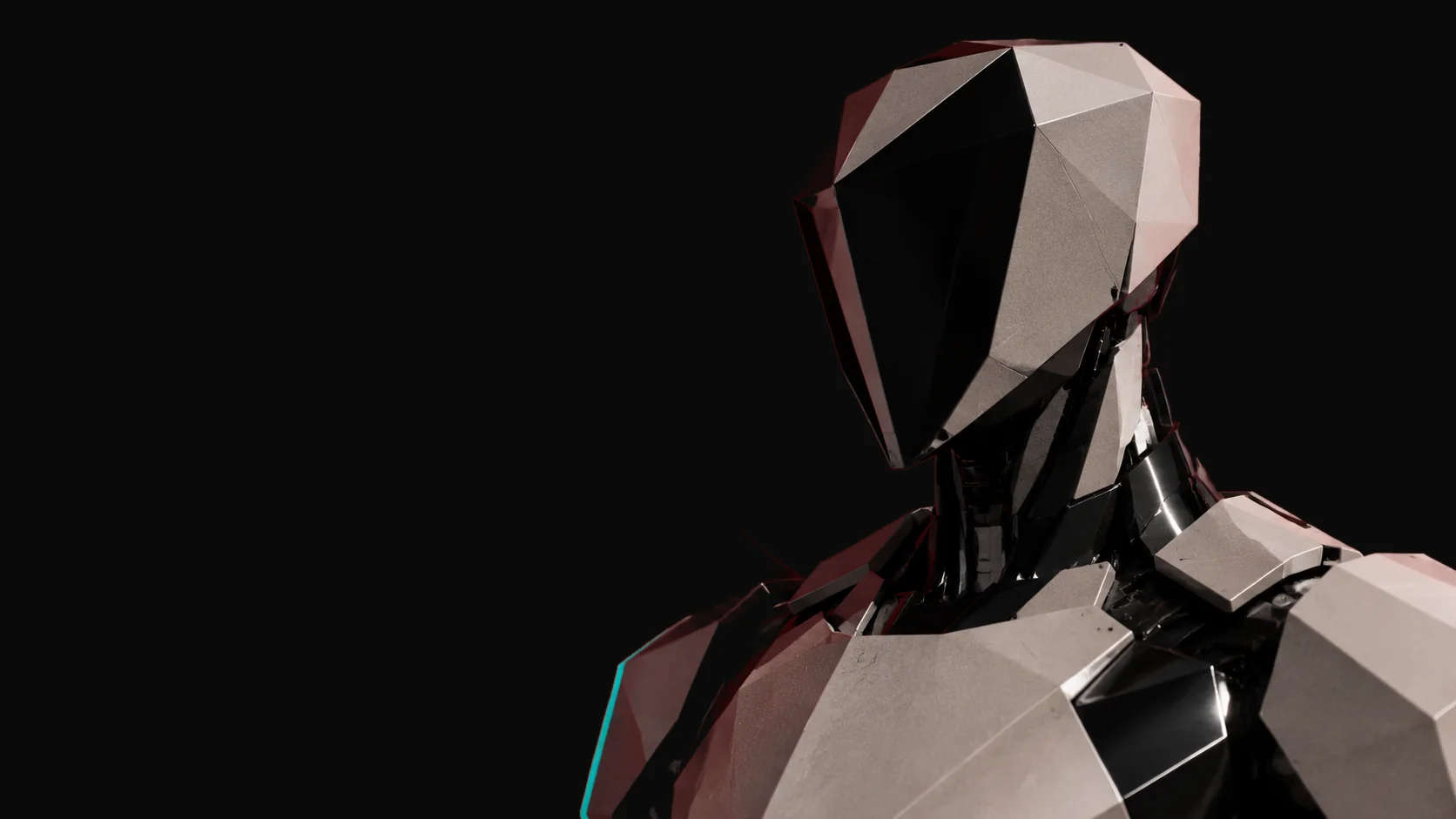
    RH-01 design study: faceted helmet and shoulders against a red wall, its shadow torn by a glitch.

    /// RH-01.STUDY_

    RH-01 design study

    RH-01 is how REDH draws embodied AI. These are its design rules, not a spec sheet: it has no performance figures because it is a study, not a product.

    • 01 · Shell

      Faceted titanium-ceramic armour

      Few, long facets and one bevel size everywhere, so a single hard light can run across the whole shell.

    • 02 · Face

      Glossy black visor plane

      No face. One black glass plane catches one sharp highlight.

    • 03 · Neck

      Three-segment neck

      A long neck in three stacked rings, the mechanism inside.

    • 04 · Accent

      REDH red inlay

      Two to four red lines cut into the armour, one tiny signal mark. Nothing else carries colour.

      • Satin titanium-ceramicOuter armour
      • Black structureJoints and under-layer
      • Glossy black glassVisor
      • REDH redInlay, the only accent

      05 · Materials

      Three materials, one accent

    • 8heads tall

      06 · Proportion

      Long neck, wide shoulders, narrow waist, long legs.

    • 2–3joints in sight

      07 · Mechanism

      Jewel joints only

      The mechanism stays under the armour. Two or three glossy black joints show, like jewellery.

    /// FORGE.SUPPLY_

    One package for robotics teams

    • 04.1Capture lines Teleoperation rigs, motion-capture gloves and handheld grippers that record demonstrations in real settings.
    • 04.2Data processing Alignment, slicing and labelling across embodiments, exported to common training formats.
    • 04.3Training compute Compute services for VLA and world-model training, booked by the run.
    • 04.4Hardware Selection and delivery of arms, dexterous hands and sensors.

    Capital

    ¥93.5B

    Embodied-AI funding in China, H1 2026, across 322 deals19

    Shipments

    +432%

    Global humanoid robot shipments, H1 2026, year on year20

    05Equilibrium/// REDH.NET_

    Three businesses,
    one network.

    Prism brings traffic from the model side, Lens brings customers from the brand side, Forge connects intelligence to the physical world. All three run on one layer for routing, metering and compute.

    /// LOOP_01 / 04

    1. 02PrismModel calls come in through one API, are routed to an upstream and metered on the way back.
    2. 03LensLens puts the same models to work on brand questions every day, on the same routes and the same meter.
    3. 04ForgeRobot data and training runs book their compute through the layer and land on the same meter.
    4. 05One layerRouting, metering and compute sit under all three businesses.

    Diagram: Prism, Lens and Forge each connect down into one shared layer with three tracks, routing, metering and compute; traffic from all three flows along the same tracks.

    /// HOW THE LOOP TURNS_

    1. 1Prism carries the calls and meters every one.
    2. 2Lens puts the same models to work on brand questions.
    3. 3Forge books training compute through the same layer.
    06Investor relations/// REDH.IR_

    For the next round, we are looking for fellow travellers.

    /// WHY NOW_

    • Model traffic

      22B

      API tokens Gemini models process every minute21

    • Model spend

      US$12.5B

      Enterprise spend on foundation-model APIs in 202522

    • Search to answers

      US$80B+

      SEO market whose foundation, a16z writes, “just cracked”23

    • Robots Forecast

      750K

      Humanoid robots IDC expects to ship worldwide in 203024

    1. Alphabet, Q2 2026 results, July 2026 (SEC filing, exhibit 99.1)
    2. Menlo Ventures, The State of Generative AI in the Enterprise, December 2025
    3. a16z, How Generative Engine Optimization Rewrites the Rules of Search, May 2025
    4. IDC, September 2026: forecast, not an outcome